
European pharmaceutical legislation reform: Overview and implications for innovation, access and public health
- 1 Replek, Kozle 188, Skopje, Republic of North Macedonia
Received 30 October 2026 · Accepted 31 October 2026 · Published 31 October 2026 · Corrected 9 November 2026
DOI: https://doi.org/10.5281/zenodo.23839390
Article PDF · Original poster (PDF)
- views
- 21
- downloads
- 10
- countries
- 7
Since publication · journal site and Zenodo archive · robots excluded
Abstract
Introduction
On 11 December 2025, the European Parliament and the Council of the European Union reached political agreement on the reform of the EU pharmaceutical legislation, the most significant overhaul of the regulatory framework in over two decades. The reform aims to modernise the entire lifecycle regulation of medicines for human use, supporting digitalization, and innovation from early development through market access and post-authorisation safety monitoring. In the final programming document 2026–2028, EMA revision introduces new mechanisms to foster innovation, evaluate clinical trials through FAST‑EU (Facilitating and Accelerating Strategic Trials), improve patient access to medicines, address public health challenges including antimicrobial resistance (AMR), enhance regulatory support for pediatric and rare diseases, advance digitalisation, and promote environmental sustainability in pharmaceutical activities (EMA, 2025).
Materials and methods
A descriptive review and qualitative analysis of relevant European pharmaceutical regulatory documents, EMA publications, EU legislative initiatives, and scientific literature were conducted. Official regulatory sources, including EMA guidelines, programming documents, and EU legislation, were reviewed to identify and assess the key proposed regulatory changes. Particular attention was given to accelerated assessment, conditional marketing authorisation, antimicrobial resistance (AMR), and the FAST-EU initiative. The findings were analysed and synthesised to evaluate their potential implications for pharmaceutical innovation, patient access, and public health.
Results
Accelerated assessment: Reduction of the marketing authorisation assessment timeline from 210 to 150 days for medicines addressing major public health needs or representing significant therapeutic innovation.
Conditional marketing authorisation: Facilitation of earlier patient access to medicines addressing unmet medical needs, subject to specific conditions and continued post-authorisation data collection.
Antimicrobial resistance: Increased regulatory support for the development of new antimicrobial medicines in response to the growing global AMR threat.
FAST-EU initiative: Introduction of a coordinated clinical trial assessment framework, aiming to reduce approval timelines to a maximum of 70 days (10 weeks).
Regulatory modernisation: Greater emphasis on innovation, digitalisation, patient access, and more efficient regulatory procedures.
Conclusion
The forthcoming EU pharmaceutical legislation represents a transformative step towards a more flexible, innovation-oriented, and globally competitive regulatory environment. By integrating accelerated and conditional pathways, committing to combat antimicrobial resistance, and launching collaborative initiatives such as FAST-EU, the EU strengthens its capacity to respond to healthcare challenges and ensure patient access to safe, effective, and sustainable medicines.
Original poster
References
- References
- Daher, L. et al., 2026. The combat against antimicrobial resistance: an overview of EU recent health policies and drug regulations promoting the development of new antimicrobials. Pharm. Med. 40, 107–128. https://doi.org/10.1007/s40290-026-00601-5
- European Medicines Agency, 2025. Final programming document 2026–2028, EMA/10240/2026 Amsterdam. https://www.ema.europa.eu/en/documents/report/final-programming-document-2026-28_en.pdf
- European Medicines Agency, 2026a. European Medicines Agency pre-authorisation procedural advice for users of the centralised procedure, EMA/24037/2019, Amsterdam.https://www.ema.europa.eu/en/documents/regulatory-procedural-guideline/european-medicines-agency-pre-authorisation-procedural-advice-users-centralised-procedure_en.pdf
- European Medicines Agency, 2026b. Emergency Task Force recommendations. Guidance for applicants: the ETF scientific advice that facilitates clinical trial authorisations (SA-CTA), EMA/47386/2025, Amsterdam.https://www.ema.europa.eu/en/documents/other/guidance-applicants-etf-scientific-advice-facilitates-clinical-trial-authorisations-sa-cta_en.pdf
- European Parliament and Council, 2004. Regulation (EC) No 726/2004 of 31 March 2004. Off. J. Eur. Union L 136, 1–33. https://eur-lex.europa.eu/legal-content/EN/TXT/?uri=CELEX%3A32004R0726
- Naghavi, M. et al., 2024. Global burden of bacterial antimicrobial resistance 1990–2021: a systematic analysis with forecasts to 2050. Lancet 404, 1199–1226. https://doi.org/10.1016/S0140-6736(24)00443-9
Related posters
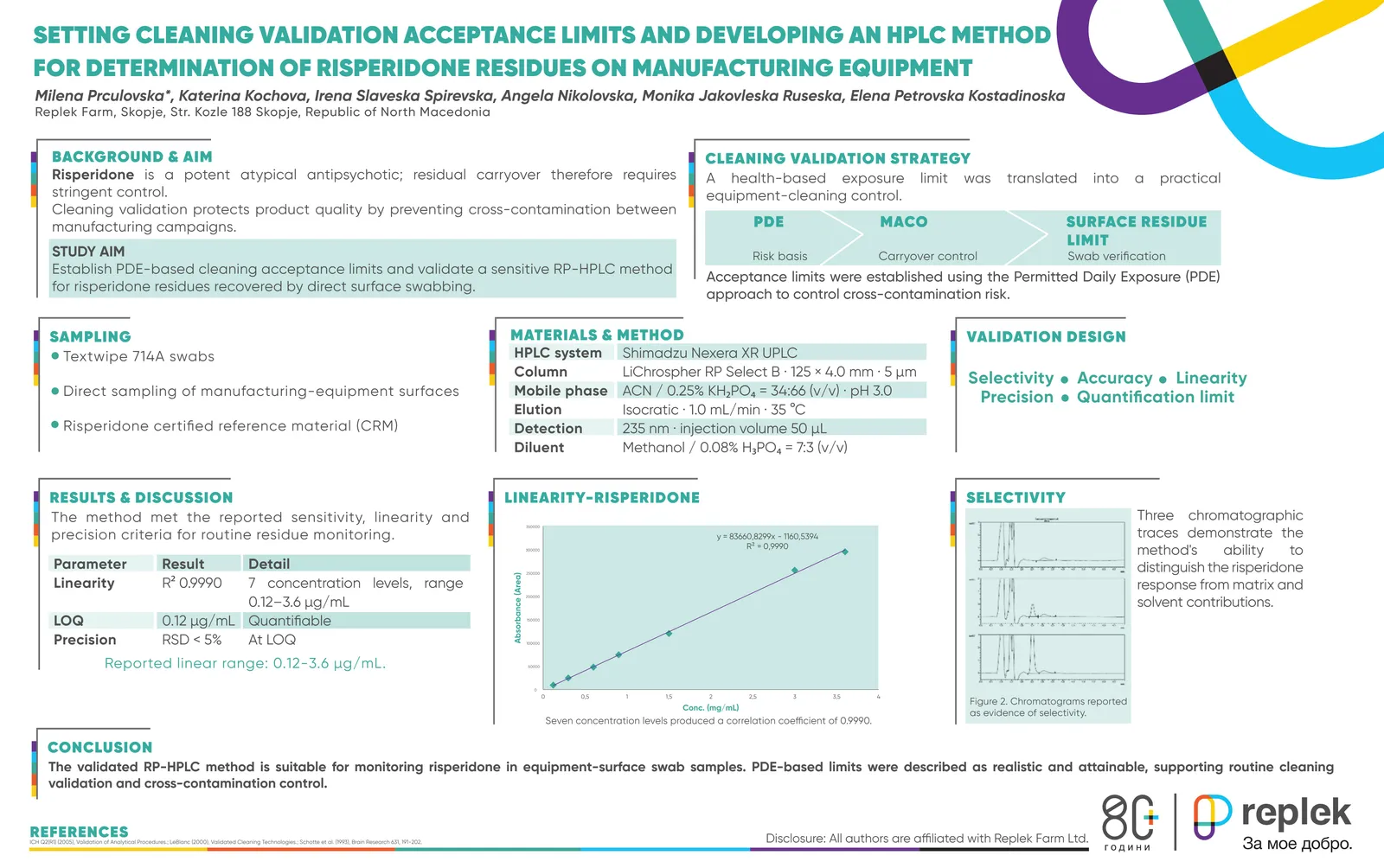 Pharmaceutical IndustrySetting cleaning validation acceptance limits and developing an HPLC method for determination of risperidone residues on manufacturing equipmentM. Prculovska, K. Kochova, I. Slaveska Spirevska and 3 others
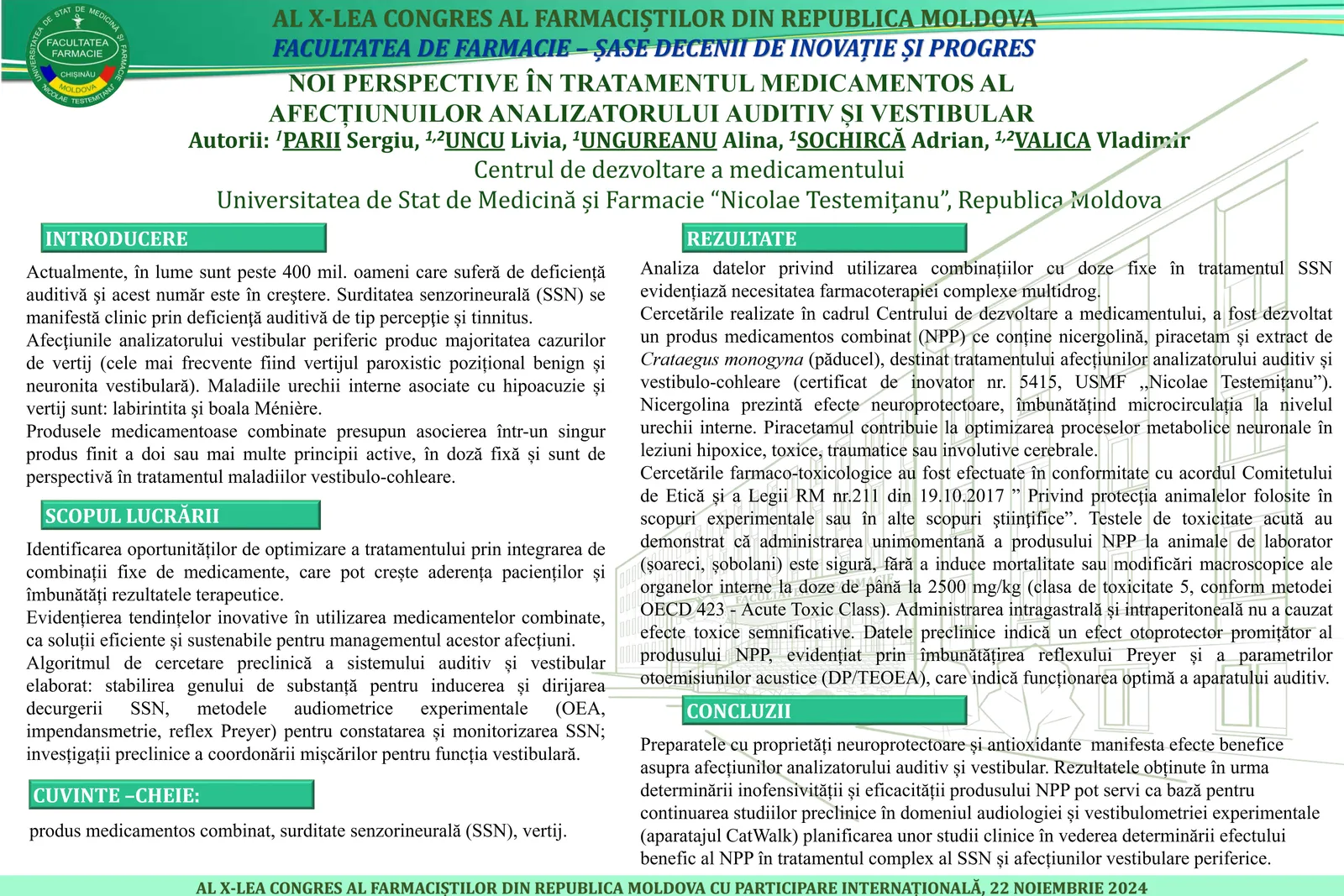 Pharmaceutical IndustryNew perspectives in the drug treatment of auditory and vestibular analyzer disordersS. Parii, L. Uncu, A. Ungureanu and 2 others